The show, the music and the night
El Patio Sevillano: the show
What happens on stage at El Patio Sevillano: the company, the palos, the props, the music of Falla and Turina, and how the night ends with sevillanas.
Book the flamenco show ↗Quick answer
The show at El Patio Sevillano is a live flamenco performance by a company of more than a dozen dancers, singers and guitarists. The venue says it presents different palos with castanets, fans, hats and capes, uses music by Falla and Turina, and ends with every artist on stage for a joint bulería and then the sevillanas. Programmes change from night to night, so the shape of the evening is the reliable part.
A company, not a duo
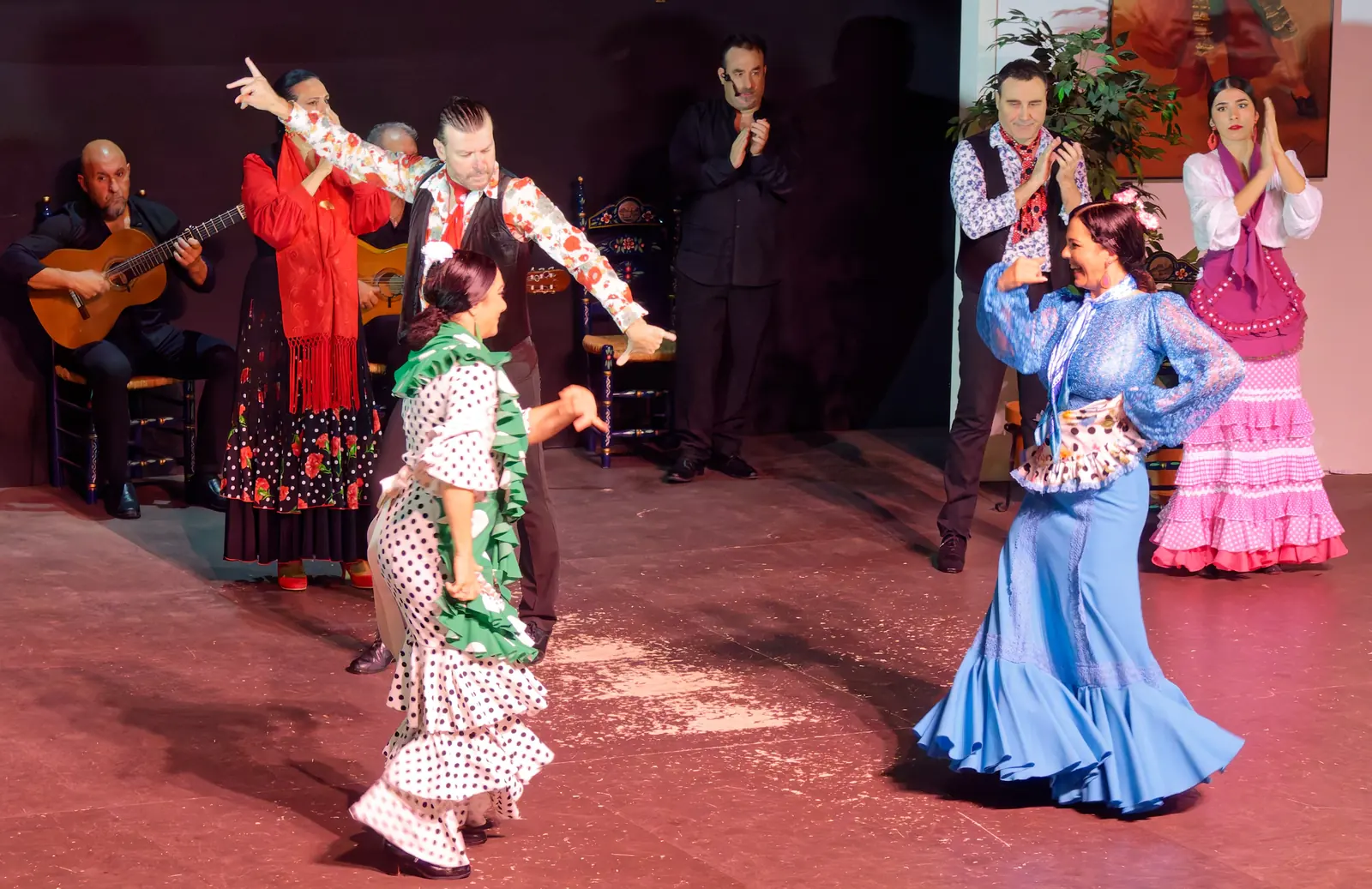
The first thing to know is the scale. The booking page speaks of an ensemble of more than a dozen artists, and the venue's own site says dancers, singers and guitarists all perform live. That is a company format, with several dancers sharing the stage in turn, and not the two or three artists of a small room. Photographs from an October 2024 evening show a blue tile sign with the venue's name above the stage, seated guitarists at the back and dancers moving in front of them in dresses of many colours. The photographs from that evening include solos, duets and pieces for the whole group, which is the variety a company format allows.
Flamenco in three parts
In UNESCO's entry, flamenco joins singing, called cante, dancing, called baile, and instrumental playing, called toque, and it names Andalusia in southern Spain as the art's heartland. A tablao show gives you all three at close range: a voice, a guitar and dancers. UNESCO lists castanets, claps and stamping feet among the other sounds, which is why the clapping of the artists sitting at the back is part of the music, not background noise. Together the three are the whole of the form, and every dancer on the stage is answering the voice or the guitar, not performing alone.
The stage and its set
Wikipedia says tablaos are often decorated in a typically Spanish way, with embroidered silk shawls, photographs of famous people, bullfighting clothes and capes. Photographs of the show at El Patio Sevillano fit that description: a large black-and-white picture of a courtyard scene hangs behind the artists, a poster of a bullfighter hangs beside the stage, and the guitarists sit on painted wooden chairs with rush seats. Together they read as an Andalusian patio brought indoors, which suits the venue's name.
Palos, the named forms
Flamenco is sorted into palos, forms identified by rhythm, mode, verse and origin. Wikipedia calls the classification popular and sometimes inconsistent, so do not expect a neat syllabus. It does say that soleares and siguiriyas are solemn and are sometimes called cante jondo, deep song, while tangos and bulerías are fast and festive. The venue's site says the show offers the different palos of flamenco with their different styles, and it names two other strands beside them. You do not need the names to follow the night, but a few words help it make sense.
- Soleá and siguiriya: the slow, serious forms often linked with cante jondo, deep song
- Bulería: the fast form, on a twelve-beat cycle, that often ends a gathering
- Sevillanas: Seville's folk music and dance, the first form most would-be flamenco dancers learn
Read next: Flamenco words for a first night
Props and costume
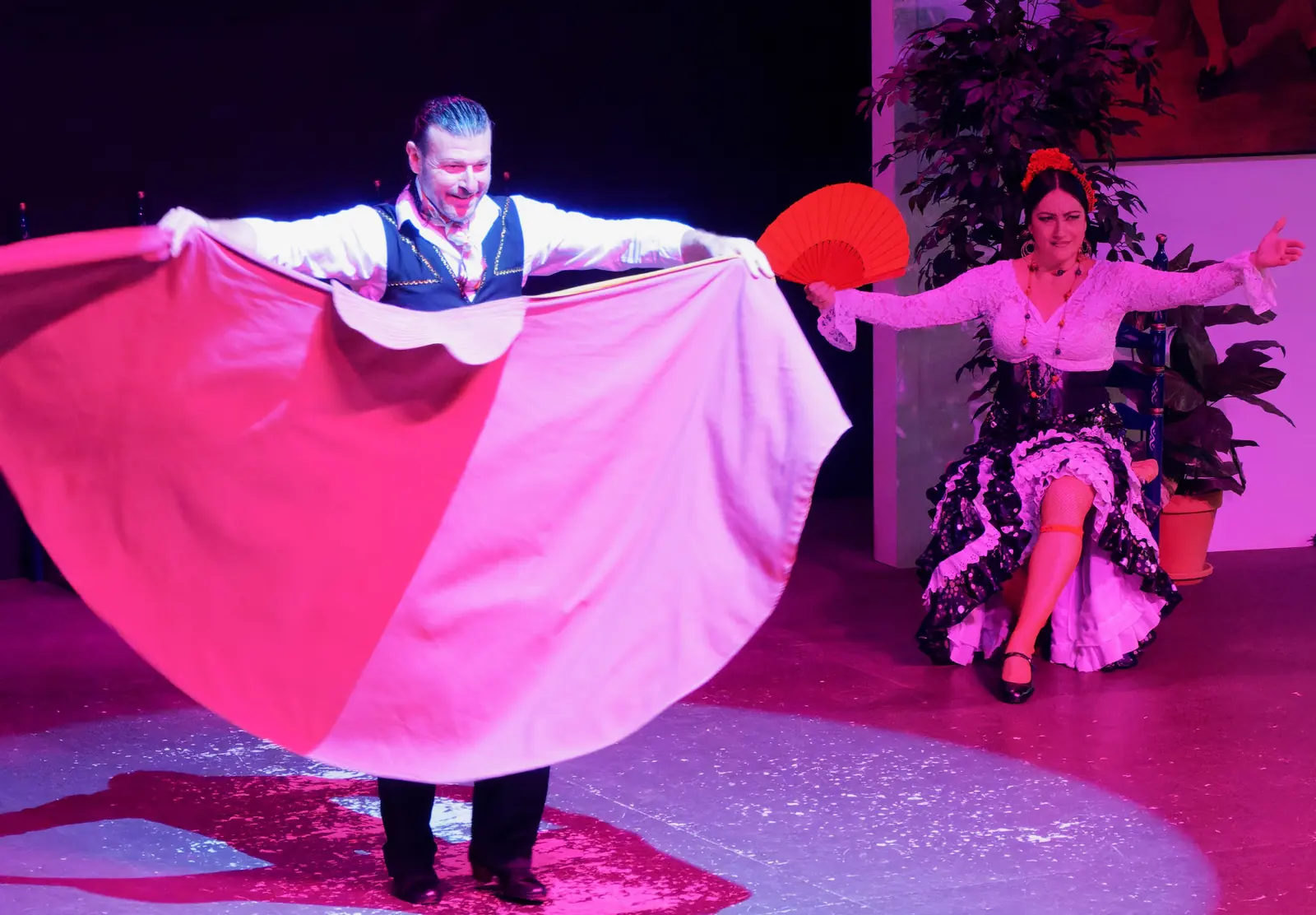
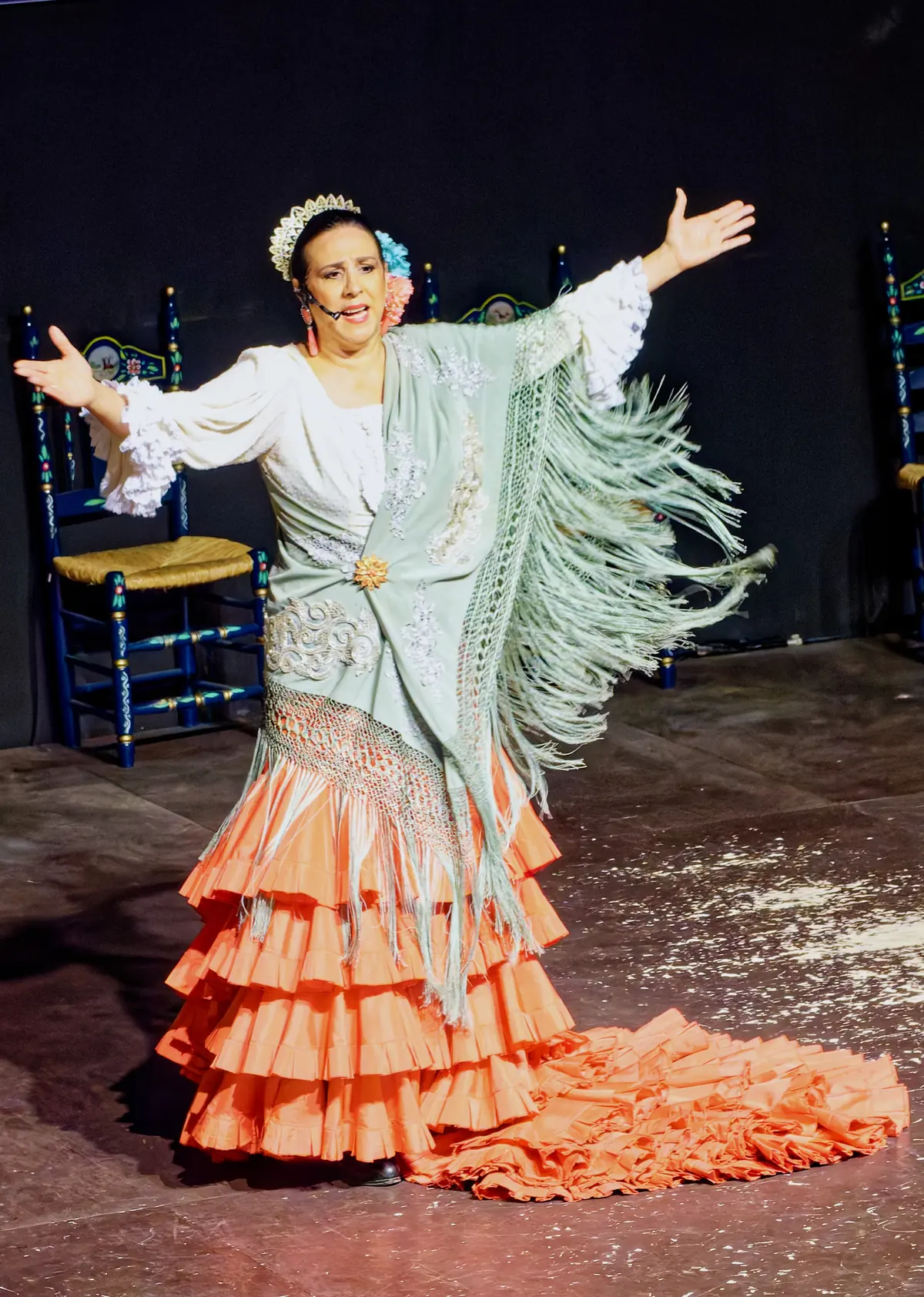
The venue lists a set of props: palillos, the Spanish word for castanets, fans of different kinds, hats and capes. It says the capes are used in the staging of Carmen. Wikipedia notes that the Manila shawl, an embroidered silk shawl, is particularly prominent in the costume of flamenco dancers. In the photographs from the show you can see long fringed shawls, ruffled dresses in polka dots and florals, and a large cape held out wide. None of these props is guaranteed on a given night, because the programme is the company's to choose. Look at the hands too: the castanets and the fans are played, not just carried, and the sound of the castanets is part of the rhythm.
Falla, Turina and Spanish song
The venue says the show uses music by Manuel de Falla and Joaquín Turina alongside the music of classical Spanish dance and popular flamenco. Turina was born in Seville and Falla in Cádiz, and Wikipedia says that Andalusian flamenco, and cante jondo in particular, strongly shaped many of Falla's works. The venue also lists canción española among the styles. Wikipedia describes it as a form of Spanish popular song, also called copla, that flourished in the 1930s and 1940s. The evening is wider than a pure flamenco recital, which suits a first visit. Expect at least one piece that feels more like a dance recital than a flamenco gathering, and let it change the pace of the night.
The artists behind the show
The venue's show page carries short profiles of its dancers, singers and guitarists. They describe training at conservatoires and dance schools, one at the school of the dancer Matilde Coral, and work on stages across Europe and in the Bienal de Flamenco. A singer's profile says she is the daughter of a dancer who opened El Patio Sevillano and later received a national dance prize. The cast changes, so these profiles describe the kind of artist you may see, not who will be on stage on your date. Check the venue's show page if you like to know who is behind a performance.
The finale: a bulería, then sevillanas
The venue says the show ends with all the artists on stage, first in a joint bulería and then in the sevillanas. Wikipedia describes the bulería as a fast form that often ends a flamenco gathering, and describes sevillanas as a folk dance of Seville danced at fairs and festivals, with a pattern of turns that visitors often mistake for flamenco itself. The finish therefore does two jobs: it gives the company a last burst of energy and it sends the room home with the dance of the city you are in. It is the part of the show where it is easiest to feel what a flamenco evening is for.
How to watch your first show
Keep an eye on the guitarist too, not only the dancer. The guitar sets the rhythm, called the compás, and the dancers answer it. Listen for the clapping and the shouts of encouragement from the artists at the back. Wikipedia calls this jaleo and lists olé among the common calls. You can follow the mood of the room before you decide whether to join in, and a phone is best left in a pocket while the artists perform. If the dancing is hard to read, follow the feet: the footwork is the most exact part of the art, and it keeps time with the guitar.
Who this isn't for
This is a staged show for an audience, not a gathering of friends in a back room. If you want to hear one singer and one guitarist at arm's length, you will find a larger stage less private. If you want a fixed programme, the company changes its pieces and its cast. And if you are after a late, loud night out, the show is a seated, watched performance with its own rhythm of applause and silence. It also asks for an hour and a half of attention, which is a lot for very young children.
Read next: Choosing a Seville flamenco night
Frequently asked questions
What happens at the El Patio Sevillano show?
A live company of dancers, singers and guitarists performs different flamenco palos with props such as castanets, fans and capes. The venue says it ends with a joint bulería and the sevillanas.
Is the music live?
Yes. The venue's site says the whole staging is live, with dancers, singers and guitarists on stage.
Will I see a particular dancer or piece?
No ticket promises that. The programme and the cast change from night to night.
Do I need to know flamenco?
No. The dance and the music carry the evening, and the closing sevillanas are a good way to meet the form.
What are palos?
Palos are the named forms of flamenco, identified by rhythm, mode, verse and origin. A show usually moves through several of them.
How long should I plan to sit?
The venue's site says 90 minutes without an interruption, and the booking page shows 75. Plan for the longer figure.
Sources
- El Patio Sevillano: the show (the venue's site, in Spanish)
- Palo (flamenco) (Wikipedia article)
- UNESCO intangible heritage page on flamenco: cante, baile and toque
- Bulerías (Wikipedia article)
- El Patio Sevillano (the venue's site)
- Sevillanas (Wikipedia article)
- Joaquín Turina (Wikipedia article)
- Jaleo (Wikipedia article)